Transparencies and nets reconfigure 2027 footwear

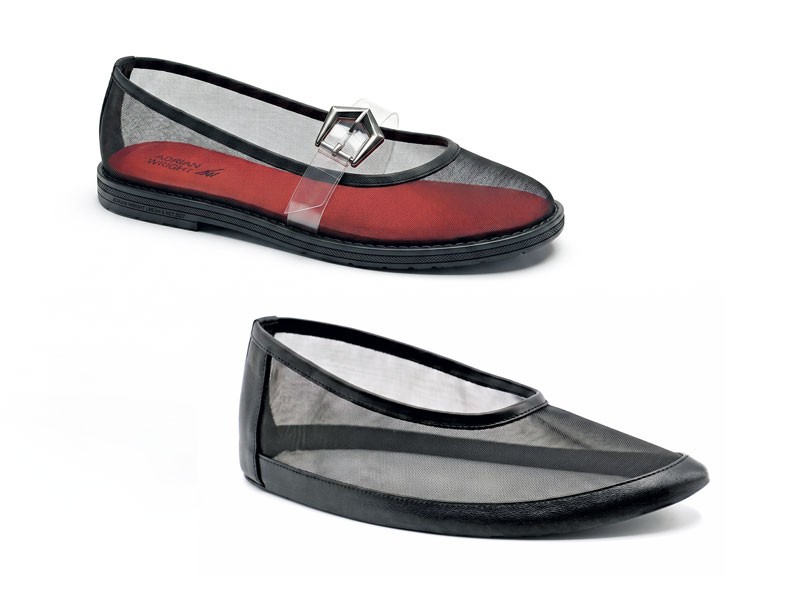
For summer 2027, the incorporation of transparent materials in footwear introduces new demands in product design and construction. The visibility of the foot and of the footwear structure ceases to be an exclusively aesthetic resource and begins to condition technical decisions linked to support, assembly and finishes.
In this context, transparency visually reduces the layers and leaves uppers, reinforcements and components exposed. This makes it necessary to rethink the construction solution, since each element must fulfill its structural function without concealment.
Mesh is consolidating itself as one of the main resources within this line. Its net-like structure, available in different densities and rigidities, allows the development of uppers with support, if selected according to the design. The firmer variants provide stability; the more open ones require technical support to avoid deformation.
Within this same direction coexist technical fabrics such as mesh, open weaves with greater elasticity and translucent textiles taken from other segments. Net-like structures expand the possibilities beyond traditional mesh, but present less dimensional control, which requires working on anchor points and a precise distribution of tensions.
Materials such as tulles or veils used in apparel are also beginning to be incorporated. Their application in footwear requires evaluating resistance, reaction to lasting and compatibility with production processes.
In products with a high level of transparency, finishes acquire a structural role. The collar must be resolved with elements that provide stability without altering the reading of the material. The incorporation of trims allows control of edge deformation and support of the shape.
The toe and heel require a specific approach. The greater exposure of the foot reduces the possibility of concealing reinforcements, which makes it necessary to work with lighter components or components integrated into the design. The location, thickness and flexibility of the counter become critical variables to maintain the shape without visual interference.
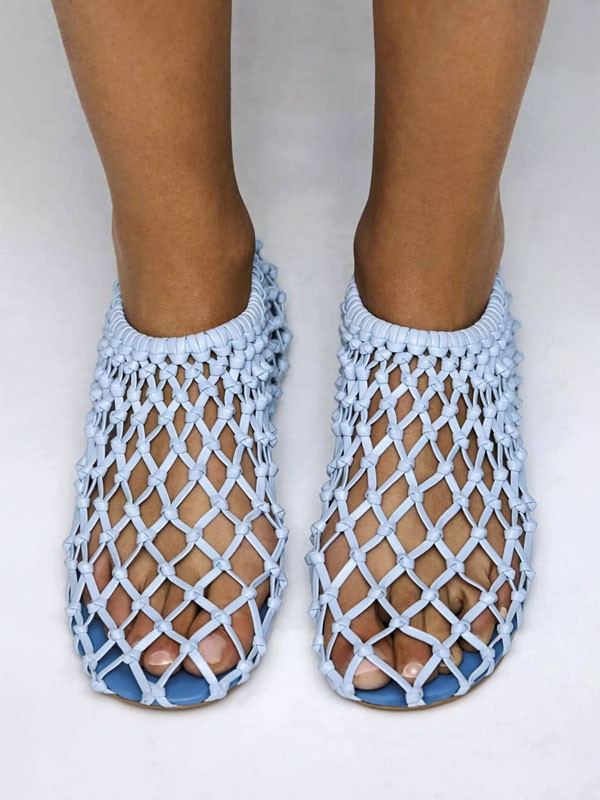
Braiding introduces a construction logic based on the formation of the upper from strips. This process, generally manual, is developed on a mold and requires precision in measurements to guarantee stability.
For industrial productions, this resource can be transferred through specific solutions. The incorporation of a braid/band in the lasting area makes it possible to stabilize the whole and facilitate its handling by machine. This development requires low pressure and process control to avoid displacement or deformation.
The application of transparent materials, nets and braiding demands repeated testing. The interaction between structure, tension and finishes requires each stage of development to be validated, both in manual and industrial processes.
In this scenario, transparency not only introduces a new aesthetic direction: it requires reviewing structure, finishes and assembly methods in products where every decision remains visible.
The complete development of this proposal can be seen in the video linked to the QR code in the article, where its practical application on a ballerina flat made in black mesh can be observed.