Last shaping

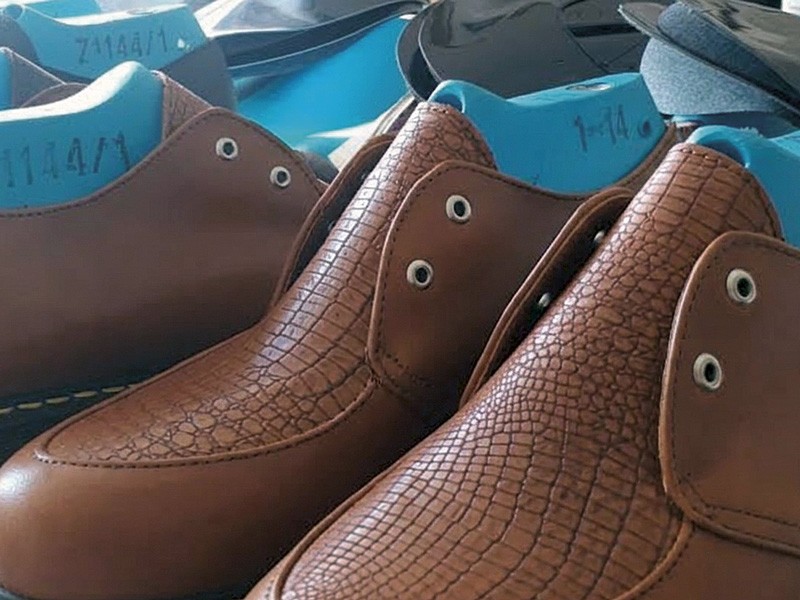
Last shaping is the stage in which footwear components (upper, reinforcements and lining) adapt to the three-dimensional shape of the last to acquire their final form, volume retention and structural stability.
The materials involved in this operation are divided into structural materials (upper and lining) and thermal or chemical reinforcement materials.
These are the key elements responsible for shape memory in the toe-cap and heel areas. They require activation by heat or solvents to adapt to the last and harden upon cooling or drying.
Characteristics: Made from synthetic resins (polymers, EVA or styrene) on textile or non-woven backings.
Properties: They are thermally activated (generally between 90°C and 130°C). When cooled on the last, they provide high rigidity, elasticity and excellent shape memory. They are standard materials in casual, athletic and dress footwear.
Characteristics: Sheets impregnated with cellulose nitrate or acetate.
Properties: They are reactivated by immersion or treatment with solvents (such as acetone or other reagents). They are very thin, adaptable to complex geometries and provide high hardness, although their use has declined due to environmental regulations.
Characteristics: Leather fibers bonded with latex or sheets of vegetable-tanned bovine leather.
Properties: They require prior moistening for shaping. They provide superior structural rigidity, high breathability and firmness, making them essential in high-end, handcrafted or safety footwear.
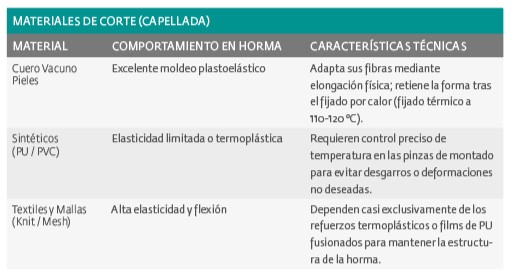
Their behavior during stretching and traction over the last varies according to the nature of the outer material. See table.
These form the base onto which the lasted upper is shaped and secured.
Cellulose Board / Cellulose Fiber: Lightweight, flexible and economical. Widely used in lightweight and athletic footwear.
Reconstituted Leather: Provides structural rigidity, moisture absorption and long-lasting dimensional stability for dress or work footwear.
Write us! marketing@serma.net