The latest technological trends

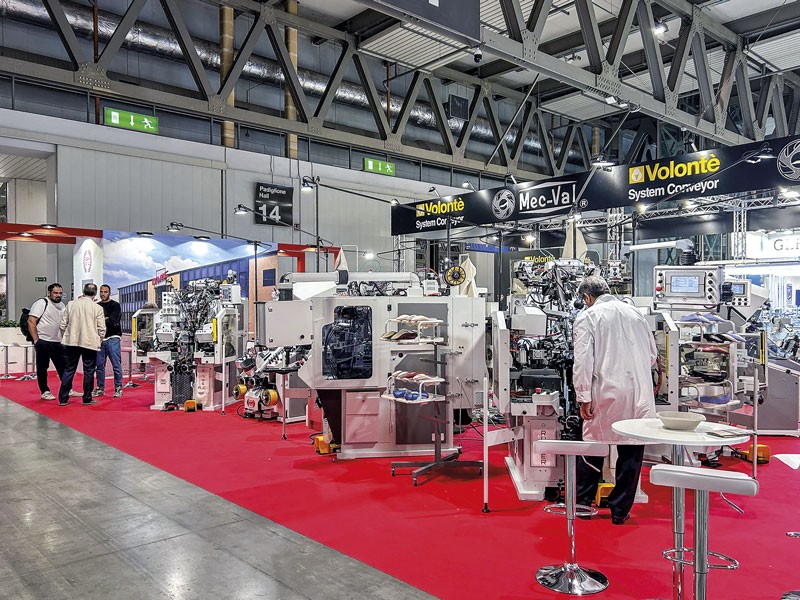
The 52nd edition of SIMAC TANNING TECH (held at Fiera Milano Rho) was marked by a structural transition from standalone machinery to interconnected, intelligent and decarbonized production ecosystems.
AI-powered defect detection: Advanced development of thermal and hyperspectral cameras combined with machine vision for the automatic digitization of hides. The software identifies imperfections and thickness variations in milliseconds, reconfiguring cutting areas in real time.
Dynamic nesting algorithms: AI-powered geometric optimization tools designed to maximize the utilization of leather and synthetic materials, reducing physical waste before the die-cutting or cutting stage.
Digital twin platforms: Virtual monitoring of complete assembly lines to simulate mechanical wear, predict bottlenecks and estimate plant energy consumption before scaling up production.
Adaptive robotic cell: Articulated arms and cobots designed for complex tasks such as scraping, roughing, automated gluing, and handling during cutting and stitching, without manual intervention.
Internet of Things (IoT) connectivity: Direct integration within Industry 4.0/5.0 architectures, where each machine transmits real-time operational telemetry to corporate ERP and MES systems for predictive maintenance.
Digital Product Passport (DPP): Hardware and software modules integrated into machinery to ensure end-to-end traceability, from the wet-blue stage in the tannery to the finished footwear product.
Unified data ecosystems: Standards for exchanging environmental and industrial metrics among chemical suppliers, tanners and footwear manufacturers.
Recirculation and zero liquid discharge (ZLD): Advanced systems for treating and filtering tannery effluents, optimizing chromium recovery and reducing water consumption per square meter of processed leather.
Decarbonization of thermal processes: Drying, setting and molding machinery equipped with energy-efficient components that reduce thermal impact and minimize the operational carbon footprint.
WINTECH
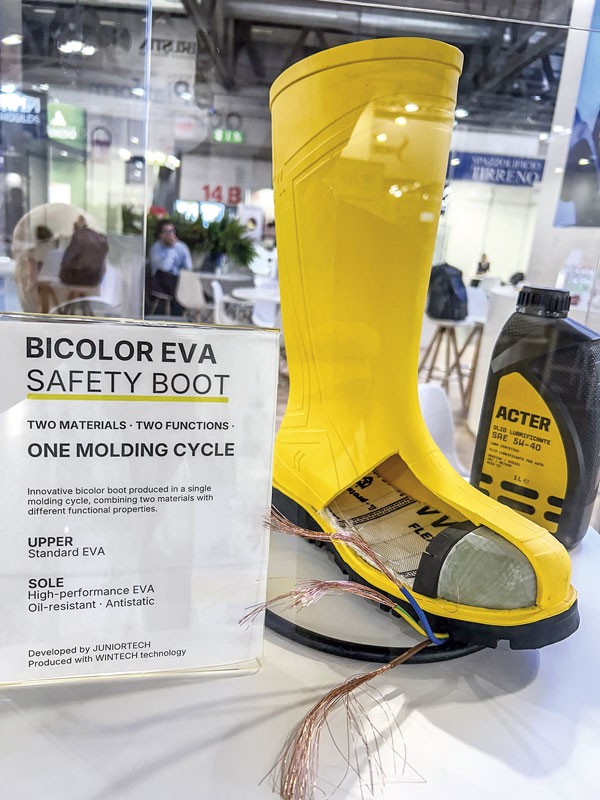
New WEX injection molding machine for producing two-color, dual-density EVA boots. The big news is that these boots are injection-molded in a single process using standard EVA for the upper and a different, higher-density EVA for the sole, providing enhanced grip, dielectric properties and resistance to oils and fuels. Both EVA formulations expand simultaneously, while cross-linking ensures a strong bond between them. The new system makes it possible to obtain a more economical product than traditional two-color, single-density EVA footwear. This technology can also be applied to soles.
MAIN GROUP
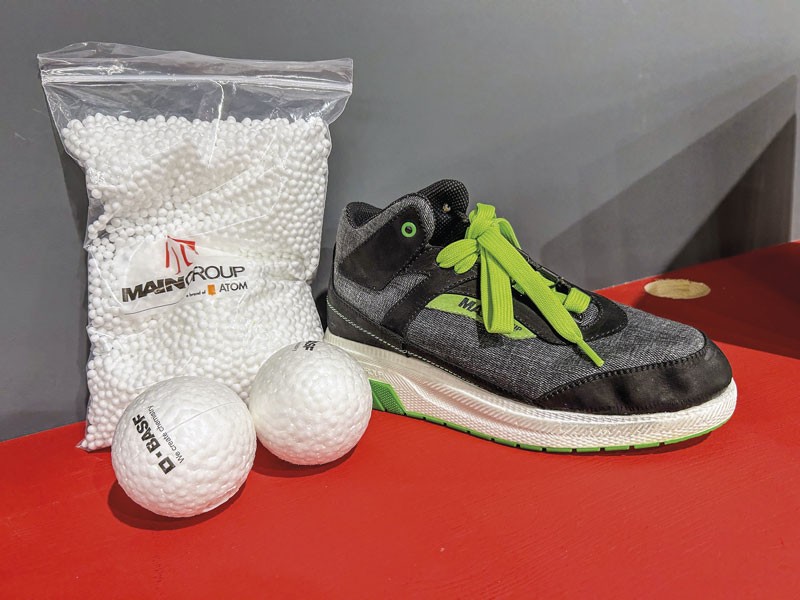
The company presented the AURORA SUPerior system for direct injection molding of soles onto footwear uppers. The technology introduces nitrogen in a critical state during TPU expansion, reducing density while increasing elasticity, resilience and energy return, and eliminating the marbled effect in expanded TPU. The footwear is completed in a single cycle, with consistent quality, repeatability and maximum operational efficiency.